Tire Care and Maintenance

Tire Care and Maintenance |
|


Tire Buyer's Guide | General Information | Tire Library | Fitment Guide | Feedback | Dealer Locator | Tire Care | Home Page | Motorcycle

However, a tire's job is more than to hold a load.
It must transmit handling (acceleration, braking, cornering) to the road.
Cornering forces are transmitted to the rim in a similar manner to load.
Acceleration and braking forces rely on the friction between the rim and the
bead. Inflation pressure also supplies the clamping force which creates this
friction.
A tire also acts as a spring between the rim and
the road. This spring characteristic is very important to the vehicle's ride.
Too high an inflation pressure causes the tire to transmit shock loads to the
suspension and reduces a tire's ability to withstand road impacts. Too low an
inflation pressure reduces a tire's ability to support the vehicle's load and
transmit cornering, braking, and acceleration forces. Finding the optimum
inflation pressure requires extensive engineering efforts on the part of tire
and vehicle manufacturers.
Underinflation can cause many tire related
problems. Since a tire's load capacity is largely determined by its inflation
pressure, underinflation results in an overloaded tire. An underinflated tire
operates at high deflection resulting in decreased fuel economy, sluggish
handling and excessive shoulder wear. High deflection also causes excessive heat
buildup leading to catastrophic tire failure.

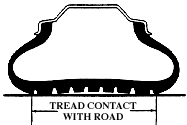
Undetected punctures, bruise damage, cuts, and rim/
valve damage may produce more rapid air loss. Under inflated tires in general
and performance radials in particular, may not convey a message of under
inflation to the driver until heat failure or rim dislodgment occurs.
Therefore, cold inflation pressures must be checked as often as possible.
NOTE: For safety and vehicle performance, you
should recommend to your customers that they check tire inflation pressure at
least once each month and as often as possible, when the tires are cold (ambient
air temperature or if the vehicle has not been driven for several hours).
A tire patch must be firmly adhered to the inner
liner. If a patch is not used or is incorrectly applied, air under pressure can
leak through the puncture into the body of the tire causing separation. Also a
plug must fill the in jury or puncture and seal the tread surface. Winter
driving is especially corrosive. If road salt, debris or moisture penetrates a
tire, rust in the steel belts can result, leading to separation. Therefore, a
plug must be in place to seal the tire from the outside as well.
Nails and other objects may protrude into a tire
causing internal damage that is not visible or apparent from the outside. A tire
repair can be properly made only if the tire is removed from the rim, a thorough
internal inspectio n is carried out, and repair is made from the inside out.
The three elements involved in wheel alignment are
angles referred to as caster, camber and toe. Each
affects the vehicle's performance.
Caster is the angle between a vertical line and a
line drawn through the center of the ball joints (steering axis) when the
vehicle is viewed from the side.
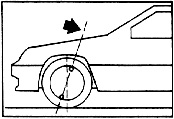
Negative Caster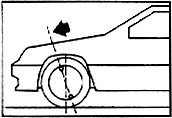
Improper caster can cause hard steering, increased
road shock, reduced straight line stability and cause the vehicle pull to one
side or the other.
Camber is the angle between a perpendicular line
and a line drawn through the centerline of the tire when the vehicle is viewed
from the front.
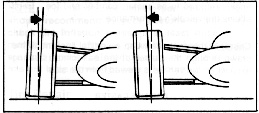
Incorrect camber causes uneven tire wear, poor
steering and vehicle stability, and vehicle pull.
Toe refers to the angle between a line through the
center of a vehicle and lines drawn through the centerlines of the tires when
the vehicle is viewed from above.
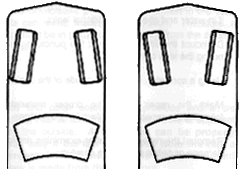
The toe adjustment is the most critical to tire
wear. Incorrect toe results in rapid and uneven wear.
When a manufacturer designs a car, engineers select
these elements (angles) and establish them as specifications for the best
overall vehicle handling performance. Failure to properly align a car's wheels
can result in excessive tire wear, excessive fuel consumption and unsafe
handling.
A tire both rolls and steers. To provide smooth
running, a tire's mass must be evenly distributed around both the rolling axis
and its centerline. A heavy spot in the center of a tread can cause bounce. This
is referred to as static imbalance.
An improperly mounted tire or a heavy spot in a
sidewall can cause wobble, or side-to-side shake. This is called dynamic
imbalance. Any such movement transmits itself throughout the vehicle. Wheel
imbalance causes forces that res ult in vibration through the vehicle's
steering, suspension and body. Imbalance is the cause of the majority of
vibration complaints. Rims and poorly matched rim/tire combinations are frequent
contributing factors.
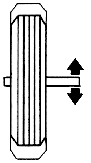

Off-car dynamic balancing is recommended because it
balances the wheel/tire unit very accurately. However it cannot compensate for
imbalance in the brake/hub assembly. Some vehicles may have imbalanced brakes.
In this case, the brake/hub must be removed and balanced separately. This gives
the optimum balance and allows for future tire rotation.
On-car electronic balancing includes the brake/hub
assembly and the wheel/tire unit, making possible an accurate balance. It is
difficult to perform a dynamic balance using this method, but it does balance
the entire rotating mas s as a unit. The wheel must be marked so it can be
reinstalled in the same location (both position on the car as well as position
on the hub) after future service work.
Wheel weights added to the inside or outside of the
rim correct imbalance as indicated by balancing equipment. While balancing may
seem a relatively simple operation, care must be taken to eliminate imbalance,
since even a minor imbalance contributes to wheel wobble and poor ride and
handling characteristics.
Tire-induced vehicle shake is most often caused
by: A heavy spot in a tire or tire/rim combination
causes a radial force which bounces the tire up and down (static imbalance) once
per tire revolution. This force increases as the cars speed increases. It is
only at higher speeds, faster than 40 mph, that this weight induced bounce
becomes noticeable. An out of round tire or wheel causes a once per tire
revolution up and down force that is independent of speed If the vibration is
not evident at low speeds but begins at higher speeds , imbalance is the likely
cause. If a bounce is felt at very low speeds, the likely cause is an out of
round tire or wheel. Sometimes a low speed bounce is caused by "flat spotting".
Make sure the tire is warmed up from several miles of driving to elimina te flat
spotting as a source of low speed bounce.
While the up and down shake or bounce results from
a heavy spot in the tread, the side-to-side shake or wobble (dynamic imbalance)
can result from poor bead seating or a heavy spot in a sidewall. If both front
tires are affected, the vibration will be added together when both tires are in
phase, and may go away completely after a corner, which causes the outside tire
to roll more than the inside tire. This tire repositioning can cause the
vibrations to cancel each other. Soon, however, the tires will be in phase
again, and the vibrations will recur. Proper balancing can correct vibrations
resulting from heavy spots in tires.
An out-of-round (runout) tire/wheel, or a stiff
spot in a tire can cause vibration even in a perfectly balanced tire. In these
situations, forces create vibrations that are present regardless of vehicle
speed. Wheels don't have force variation, but they all have some runout.
Likewise, every tire has some force variation. Each of these variations, by
itself, would not cause a problem but there will be a vibration problem if the
stiff spot or high point of a tire happens to be plac ed at the high spot on the
rim during mounting. It is easy to avoid this condition. New tires and rims are
marked with dots or similar devices. When these dots are matched, the high spot
on the tire is lined up with the low spot on the wheel, and vibration is
minimized (see Match Mounting).
(1) a tire poorly seated on the rim;
(2) a heavy spot in the
tire,
(3) a stiff spot in the tire, or
(4) an out of round tire.
The
most critical speed for tire-induced shake is from 55 to 65 mph. At this speed,
a tire rotates at 10 to 15 times per second. This is the frequency that
corresponds to the natural frequency of a car suspension for virtually all cars,
making shake a potential problem for all drivers.
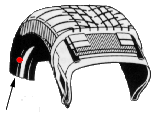
Worn shocks or suspension will allow a minor
vibration to magnify until it is felt as a major one.
Rim runout can be measured using a dial indicator.
Measure and mark the lowest spot of the inside flange and the outside flange.
Midway between these two marks is the average low spot of the rim. Mark this
spot on the valve stem side of the rim.
Tire runout is not so simply measured. Tire runout
includes both measurable runout, as well as the stiff spot in the sidewall.
Interaction between the visible runout and the stiff spot make it impossible to
find a tire's true high spot virtually without specialized equipment. This
specialized equipment, loads a tire is against a road wheel which simulates a
highway surface. The tire is rotated against the revolving road wheel, and the
radial force variation of the tire acting aga inst the road wheel is measured.
This force variation is analyzed and the high spot of the first harmonic is
marked on the tire.
Now that both the rim and tire have marks, it is
easy to mount the tire so that the harmonic mark on the tire is lined up with
the average low spot of the rim. This is called match mounting and cancels the
tire runout and wheel runout, providing the smoothest possible ride.Harmonic Marking/Match Mounting
For the
smoothest ride and least vibration, the tire must be carefully matched to the
wheel. Even though new wheels are marked, when mounting new tires on a used
wheel, the original marks may not be found. Even if they were found , the wheel
may have shifted around and must be re-measured.
Front and rear, drive and non-drive tires exhibit
different wear pattems. Front tires tend to wear more rapidly in the shoulder
area, because of steering/cornering forces. Drive tires wear more rapidly in the
tread center because of drive traction forces. On front-wheel-drive cars, front
tires wear much more rapidly than rear tires. Personal driving habits and
vehicle performance characteristics also cause tires to wear differently.
Rotating tires at frequent intervals (at 6,000 miles or less) tends to equalize
tire wear and minimize the progress of irregular wear.
Tires are considered to be legally worn out and
must be replaced when the tread depth across two adjacent grooves is 2/32". Look
for the 2/32" tread wear indicator (TWI) bars distributed around the tire
circumference at the base of the grooves. Drive tires with worn out centers or
steering tires with worn out shoulders should be replaced, even though there may
be useful tread remaining in less worn areas.
To get maximum life from a set of tires, they must
be rotated. Vehicles are engineered to operate with a matched set of tires. Even
those vehicles fitted with different size tires front and rear require a matched
set on each axle . Handling capabilities, including cornering and braking
traction depend on matched tires. If tires are not properly matched or equally
worn, vehicle performance may be compromised.
Tires should be rotated at frequent and regular
intervals. Tires can be rotated conveniently during a regular oil change, which
for most vehicles occurs every 5,000 to 7,500 miles. Dunlop recommends rotation
every 6,000 miles or less for optimum benefit.
There are many tire rotation patterns. Any routine
pattern is better than no rotation at all. The important factor in a tire
rotation pattern is that all tires eventually are placed at all applicable wheel
positions. If a vehicle is equipped with a full size spare, the spare should be
included in the rotation pattern.
If there is no choice but to mix tires:
Tire Buyer's Guide | General Information | Tire Library | Fitment Guide | Feedback | Dealer Locator | Tire Care | Home Page | Motorcycle